AI Foundation in Healthcare: Core Skills, Agents & Clinical Automation
A 3-day hands-on intensive program designed to equip healthcare professionals, clinical informaticists, and health-tech builders with foundational AI literacy and practical automation engineering skills. No prior coding experience required; designed with a low-code/no-code approach.
January 2027
3 days
In-person
Etugen University, Building 5
Seoul National University, Etugen University, and Center for Digital Health and Innovation
Program Overview
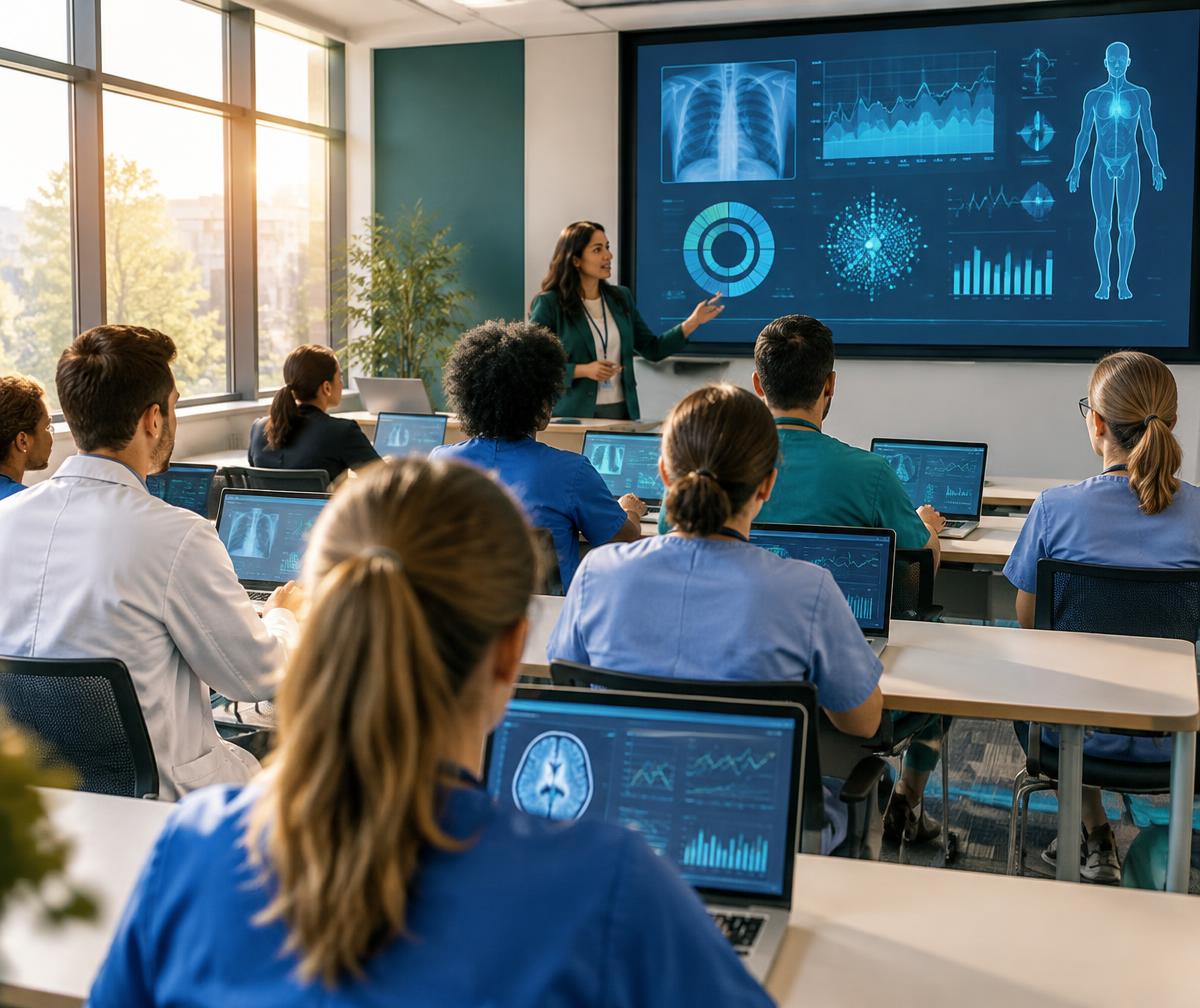
Healthcare delivery is entering a transformative era where artificial intelligence serves as a powerful partner to clinical expertise. This intensive, 3-day program is meticulously designed for medical professionals, administrators, and healthcare innovators who want to harness the power of AI without needing a background in programming.
Through an accessible, low-code approach, participants will demystify how artificial intelligence operates within modern medical environments. You will explore how foundational models, speech recognition, and autonomous agent systems can be deployed to solve real-world healthcare challenges. From cutting administrative burdens and automating clinical documentation to optimizing patient workflows and enhancing diagnostic support, this curriculum focuses on practical utility and safety.
By the end of the program, participants will successfully build, configure, and demonstrate a practical medical automation project—such as an automated speech-to-text clinical scribe or an intelligent workflow agent. Attendees will earn a prestigious certificate of completion jointly awarded by Seoul National University, Etugen University, and the Center for Digital Health and Innovation.
What Technical Skills You'll Gain
Core Machine Learning Literacy
Understand LLMs, tokenization, embeddings, and how foundational AI models operate in medical contexts without writing complex code.
Speech-to-Text Clinical Scribing
Build pipelines using user-friendly audio transcription tools to automate physician documentation and patient encounter notes.
Agentic Automation
Configure autonomous workflows that chain tasks together, from lab result interpretation to appointment routing using visual or simplified tools.
Retrieval-Augmented Generation (RAG)
Connect foundational models safely to medical guidelines, electronic health records (EHR), and clinical literature.
Data Privacy & Security
Learn safe handling practices for Protected Health Information (PHI), HIPAA considerations, and mitigating model hallucinations.
Program at a Glance
Day 1 – AI Foundations & Medical Data Basics
- Introduction to LLMs, generative AI, and fundamental terminology in healthcare technology.
- Handling clinical datasets, data preprocessing, and safe data storage practices.
- Overview of medical compliance, ethics, and patient data privacy.
Day 2 – Speech-to-Text & Clinical Documentation
- Hands-on workshop on audio processing and speech-to-text tools for medical transcription.
- Building an automated clinical scribe prototype to convert doctor-patient dialogue into structured EHR summaries.
- Prompt engineering tailored for clinical accuracy and terminology extraction.
Day 3 – Building AI Agents & Practical Automation
- Introduction to agentic workflows and automated tool-use in healthcare.
- Developing a multi-step agent for clinical task automation (e.g., automated follow-ups, triage support, or literature search) with minimal coding.
- Final project demos, deployment best practices, and certificate distribution.
Who Should Attend
Physicians, nurses, and allied health professionals interested in digital health innovation.
Healthcare administrators and IT specialists looking to implement automation tools.
Health-tech developers and data analysts entering the clinical AI space.